

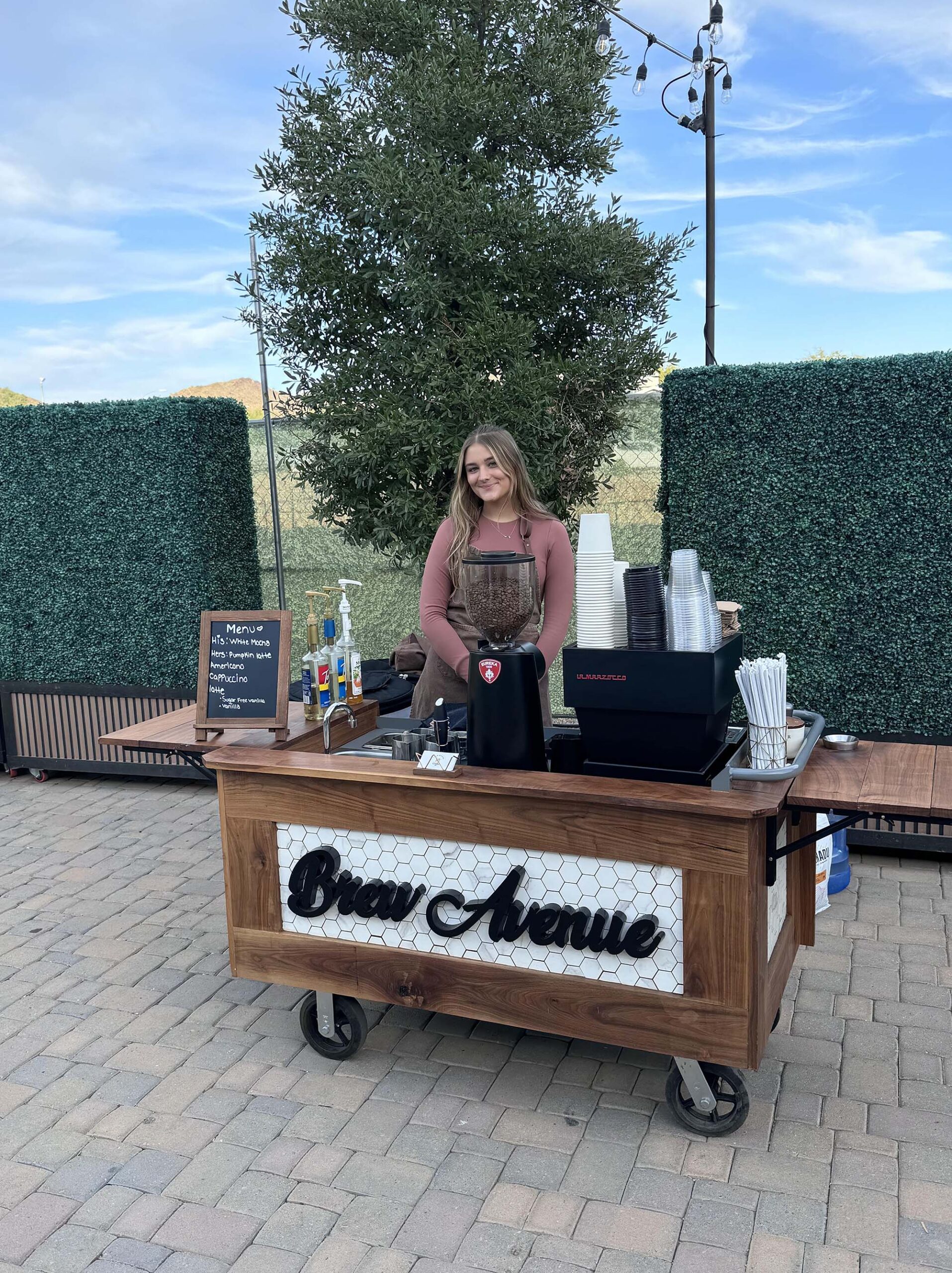
The coffee cart has come a long way. What began as a simple wooden pushcart serving hurried factory workers has transformed into a luxury centerpiece at weddings, corporate galas, and exclusive private parties. This evolution mirrors broader changes in how we consume coffee—from a quick caffeine fix to an artisanal experience. Today’s mobile carts feature electric batteries, custom branding, and baristas trained in latte art. That journey from street vendor to luxury service is a fascinating story. And at Brew Avenue Coffee, we are proud to be part of this tradition. Our coffee catering brings that rich history into the present. We are located in Phoenix, Arizona, United States, and our cart represents the best of both worlds: humble roots and modern elegance.
The Birth of the Street Coffee Cart
The first coffee carts appeared in Europe during the 18th century. In Vienna and Paris, vendors pushed wheeled contraptions through narrow alleys, selling simple black brew to laborers and merchants. These carts were barebones: a coal‑fired burner, a tin pot, and clay cups. There was no latte art, no oat milk, no cold brew. Just fuel for the working class.
By the mid‑19th century, coffee carts arrived in American cities. New York and Chicago saw pushcart vendors on nearly every corner. They served a no‑frills product—often stale, often bitter—but they filled a need. For pennies, a worker could get a warm cup without entering a tavern or a hotel.
Yet these early carts had serious limitations. No running water. No refrigeration. No sanitation standards. They were tolerated but not celebrated.
The Mid‑20th Century: Standardization and Decline
As diners and fast‑food chains spread across America, the humble coffee cart faded. Chains like Dunkin’ (founded 1950) and McDonald’s (adding coffee to the menu) offered consistent, cheap coffee in a building. Why stand on a windy corner when you could sit in a heated booth?
For decades, carts survived only in dense urban cores—Manhattan, San Francisco, Chicago—where foot traffic justified the hassle. But they remained utilitarian, not aspirational.
The 1990s: The Specialty Coffee Revolution
Everything changed with the rise of specialty coffee. Starbucks (founded 1971, but exploding in the 1990s) taught Americans that coffee could be complex, flavorful, and worth a premium. That same decade, the first wave of modern mobile carts emerged in cities like Seattle and Portland.
These new carts were different. They carried real espresso machines. Baristas learned to steam milk. Carts began offering lattes, cappuccinos, and even flavored syrups. Customers started to see carts not as a last resort but as a destination.
The 2000s–2010s: Technology and Legitimacy
Two breakthroughs elevated coffee carts from street vendor to legitimate catering option. First, battery technology improved. Carts could run for hours without a loud, fume‑spewing generator. Second, health departments created mobile food establishment permits, giving carts legal legitimacy.
Suddenly, carts could serve indoors. They could appear at weddings, corporate events, and museums. Event planners realized that a cart added atmosphere, not just caffeine. Consequently, the luxury coffee cart was born.
Our coffee catering Service grew out of this era. We saw that guests wanted more than a drink—they wanted a show. They wanted to watch the extraction, smell the fresh grind, and carry a cup that felt special. Because we are located in Phoenix, Arizona, United States, we also adapted to desert conditions, adding insulated cold brew towers and electric cooling.
The 2020s and Beyond: Luxury and Personalization
Today’s coffee cart is unrecognizable from its 18th‑century ancestor. We offer:
-
Electric, silent operation – No generator noise.
-
Custom branding – Logos stenciled in cocoa.
-
Specialty menus – Mushroom lattes, maple pecan cold brew, matcha lemonade.
-
Instagrammable design – Wood accents, copper finishes, neon signs.
-
Sustainability – Compostable cups, solar‑charged batteries.
Carts now appear at billion‑dollar product launches, celebrity weddings, and Michelin‑starred restaurant pop‑ups. They have become a symbol of taste and attention to detail.
Brew Avenue Coffee: Honoring the Past, Serving the Future
We respect the street vendors who paved the way. That is why our baristas learn the history. But we also push forward. Our cart is fully electric, uses direct‑trade beans, and partners with local Phoenix bakeries. We have served events from backyard birthday parties to Fortune 500 conferences. Through it all, we remember that every luxury service started somewhere humble.
Conclusion
The coffee cart has traveled an incredible arc—from a simple wooden pushcart to a luxury event staple. This history is not just nostalgia; it informs how we serve today. Brew Avenue Coffee combines the best of that legacy with modern technology, sustainability, and artistry. Whether you need a cart for a public food festival, a business party, or a private wedding, we bring centuries of tradition to your event. We are located in Phoenix, Arizona, United States, and we invite you to be part of the next chapter.
Frequently Asked Questions
1. When did coffee carts first become popular in the United States?
The late 19th century, particularly in New York and Chicago, where pushcart vendors served working-class neighborhoods.
2. How did specialty coffee change the cart industry?
It introduced espresso, latte art, and quality standards. Carts shifted from serving bitter drip coffee to crafting artisanal beverages.
3. Are coffee carts still considered “street food” in a luxury sense?
Yes, but the best carts now operate at both ends of the spectrum—from quick urban service to high‑end private events.
4. What makes a coffee cart “luxury” today?
Electric silence, custom branding, premium ingredients, trained baristas, and aesthetic design (wood, copper, neon). We are located in Phoenix, Arizona, United States, and our cart meets all these standards.
5. How can I book Brew Avenue Coffee for a historically themed event?
We can customize the cart with vintage decals, use antique‑style cups, and even dress baristas in period attire. Contact us for details.

 Arabic
 French
 Spanish
 Portuguese
 Deutsch
 Turkish
 Dutch
Dutch
 Italiano
 Russian
 Romaian
 Portuguese (Brazil)
 Greek
Greek