

The global construction industry is at a pivotal crossroads. As the world grapples with the urgent need to reduce carbon emissions, the materials that form the very foundation of our modern world—cement and concrete—are undergoing a radical transformation. Traditional Portland cement production is famously energy-intensive, accounting for nearly 8% of global CO2 emissions. In response, a sophisticated market for "Green" alternatives has emerged, blending ancient chemical principles with cutting-edge industrial technology to create a more sustainable built environment.
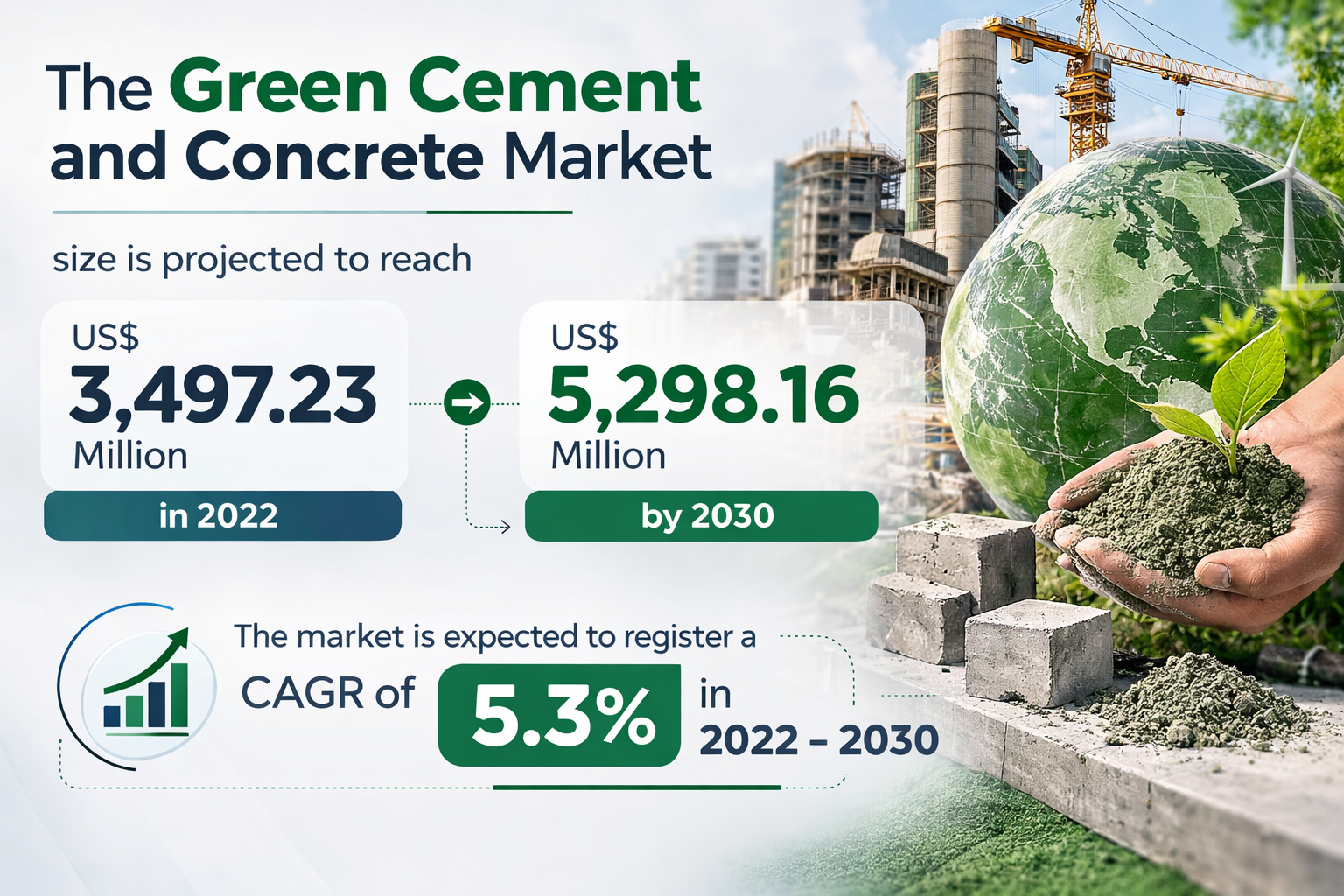
The Green Cement and Concrete Market size is projected to reach US$ 5,298.16 million by 2030 from US$ 3,497.23 million in 2022. The market is expected to register a CAGR of 5.3% in 2022–2030. This steady growth reflects a systemic shift in how developers, governments, and engineers perceive the value of "low-carbon" materials, moving them from a premium "green" choice to a baseline industry requirement.
Download Sample PDF Report:https://www.theinsightpartners.com/sample/TIPRE00005030
Strategic Market Dynamics and Drivers
The primary catalyst for the expansion of this market is the aggressive implementation of environmental regulations and the rising cost of carbon credits. In regions like the European Union, the Emissions Trading System (ETS) has made traditional, high-emission clinker production increasingly expensive. This has forced major manufacturers to pivot toward blended cements that utilize industrial byproducts such as fly ash, ground granulated blast furnace slag (GGBS), and silica fume. By replacing a portion of the carbon-heavy clinker with these materials, producers can significantly lower the "embodied carbon" of their final product without compromising structural integrity.
Moreover, the demand side of the market is being bolstered by green building certifications such as LEED, BREEAM, and DGNB. Developers aiming for high sustainability ratings are now prioritizing materials that offer verified Environmental Product Declarations (EPDs). These documents provide a transparent look at the lifecycle impact of the concrete, allowing for better-informed decision-making during the design phase of skyscrapers, bridges, and highways.
Green Cement and Concrete Market News
The sector has recently seen a flurry of activity centered on "Clinker-free" technologies and carbon mineralization. One of the most significant Green Cement and Concrete Market News items involves the commercial scaling of Carbon Capture, Utilization, and Storage (CCUS) projects within cement plants. For example, several industry leaders have inaugurated pilot plants that capture CO2 directly from the kiln and inject it back into the concrete during the mixing process. This not only traps the gas permanently but actually increases the compressive strength of the concrete. Additionally, recent news highlights the expansion of "calcined clay" technology as a viable alternative to fly ash, which is becoming scarcer as coal-fired power plants are decommissioned globally. These developments signal a move away from simply reducing harm toward actively creating "carbon-negative" building materials that act as carbon sinks over their multi-decade lifespan.
Technological Innovations in Material Science
Beyond the headlines, the technical evolution of green concrete is fascinating. Material scientists are exploring the use of geopolymers—inorganic molecules that form long-range ceramic structures at room temperature. Unlike Portland cement, which requires temperatures of nearly 1,450°C, geopolymer cements can be produced with significantly lower energy inputs.
Furthermore, the "circular economy" is becoming a reality in the concrete world. We are seeing an increase in the use of recycled concrete aggregates (RCA). Instead of sending demolished buildings to landfills, the old concrete is crushed and reused as the "stone" component in new green concrete mixes. When paired with low-carbon cement binders, this creates a truly closed-loop system for urban development.
Key Players Shaping the Industry
The market is dominated by global heavyweights who are transitioning their legacy businesses toward sustainable portfolios, alongside specialized innovators. Key players include:
-
Holcim: A leader in low-carbon concrete brands like ECOPact.
-
Heidelberg Materials: Heavily invested in carbon capture and storage (CCS) technology.
-
CEMEX: Utilizing hydrogen energy and carbon-neutral concrete initiatives.
-
CRH plc: Focusing on circular economy solutions and recycled materials.
-
UltraTech Cement: Driving the adoption of blended cements in the high-growth Indian market.
-
CarbonCure Technologies: An innovator specializing in CO2 mineralization during mixing.
-
Sika AG: Developing chemical admixtures that allow for high-performance green concrete.
Future Outlook
The future of the green cement and concrete market will likely be defined by "Performance-Based Specifications." Currently, many building codes are "Prescriptive," meaning they require a specific amount of traditional cement. As the industry matures, we expect a shift toward codes that focus on the strength and durability of the material rather than its chemical makeup, opening the door for 100% clinker-free alternatives. By 2030, the integration of Artificial Intelligence in "Smart Mix" designs will allow producers to customize concrete formulas in real-time, optimizing for the lowest possible carbon footprint based on locally available waste materials. Ultimately, green concrete will cease to be a separate "market segment" and will simply become the standard way the world builds.
Related Reports:
About Us
The Insight Partners is a leading global market research and consulting firm specializing in delivering actionable insights across various industries. Our research reports combine extensive primary and secondary research to provide accurate market intelligence, helping businesses make informed strategic decisions. The company provides detailed analysis on emerging technologies, market trends, competitive landscapes, and growth opportunities across sectors including technology, healthcare, manufacturing, and energy.
Contact Us
The Insight Partners
Phone: +1-646-491-9876
Email: sales@theinsightpartners.com
Website: https://www.theinsightpartners.com

 English
 Arabic
 French
 Portuguese
 Deutsch
 Turkish
 Dutch
Dutch
 Italiano
 Russian
 Romaian
 Portuguese (Brazil)
 Greek
Greek