

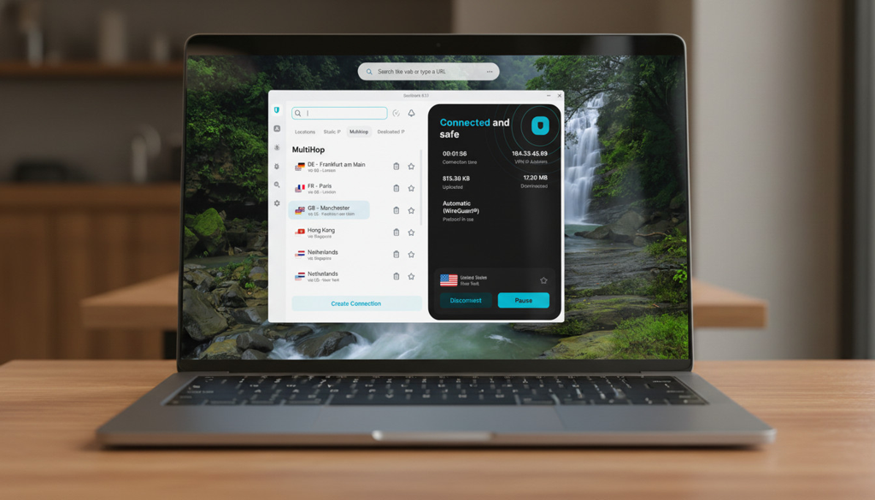
Surfshark's detailed response to a user data request showcased exceptional transparency.
However, the comprehensive nature of the information provided also highlighted the extensive user data the service retains.
This thorough disclosure, while legally compliant and commendable for its openness, prompts a closer examination of data collection practices.
The balance between operational necessity and user privacy becomes a central point of discussion.
Such a detailed data log illustrates the potential scale of information a VPN service can accumulate about its users.
Analysis of Surfshark's Data Handling Practices Reveals Extensive User Monitoring
Recent disclosures from Surfshark’s Data Subject Access Request (DSAR) report shed light on the depth of information the VPN provider collects and maintains about its users. Among the most notable data points are unique identifiers, device details, financial records, and security incident logs.
The company assigns each user a permanent UUID, linking various services such as VPN, antivirus, and privacy tools under a single profile. This identifier facilitates seamless integration across Surfshark's ecosystem but also raises privacy concerns regarding user traceability.
Device-specific data is also recorded, including device type—whether Windows, macOS, or others—and whether two-factor authentication is active. Such profiling helps optimize service delivery but adds another layer of user data retention.
Financial information is meticulously logged, capturing payment email addresses, payer IDs, transaction amounts, status, currency, and whether discounts or coupons were used. This financial trail is linked to the user’s profile via their email, making it possible to connect payment activity directly to individual identities.
Furthermore, Surfshark maintains detailed records of user subscriptions, noting their status (active, canceled, or expired) along with start and end dates. This ongoing tracking enables the company to monitor user engagement over time.
A particularly sensitive aspect is the malware detection log, which details every threat identified by Surfshark’s antivirus tool. Entries include malware names, threat types, the device involved, and the user’s country at detection time. While this data may assist in security management, its storage in a centralized database poses significant privacy questions, especially since the data reflects local infections rather than anonymized, session-based records.
Support tickets are also archived, linked by reference numbers and timestamps, providing a comprehensive history of user interactions with customer service.
Surfshark asserts that all data collection serves specific purposes such as service provision, analytics, compliance, and customer support. However, the granularity of the stored information, particularly malware logs and device profiles, prompts privacy advocates to question the necessity and scope of such data retention.
The company defends its practices by claiming that centralized threat monitoring benefits households managing multiple devices under one account. A Surfshark spokesperson explained that this approach enables users to oversee security threats across all devices via a single dashboard, aiming to enhance family safety.
Nevertheless, the persistent linkage of email addresses to user profiles means that in the event of a data breach, user identities could be exposed. This approach contrasts with privacy-conscious alternatives like Mullvad or Windscribe, which minimize data collection by avoiding stored payment details or allowing account creation without email addresses.
While Surfshark maintains that its approach balances security and privacy, the detailed logs, especially malware histories tied to specific devices and locations, highlight ongoing tensions between user privacy and operational transparency in VPN services.
When we think about online privacy, we often imagine disappearing without a trace. Yet Surfshark's data subject access request paints a different picture—one of long-term data retention.
The company holds onto payment records and promotional codes (such as comeback_70) for more than seven years, creating a lasting connection between your actual banking details and your online identity.
With cyber threats growing more advanced, a critical question emerges: does keeping such identifying information for almost ten years serve a legitimate purpose? Many users feel the potential for data breaches creates more danger than benefit.
A company representative defended this practice, stating that retaining payment data "is strictly a matter of compliance with anti-money laundering, fraud prevention, and legal accounting obligations."
They further explained that their methodology "is designed to balance user privacy with necessary account security, proactive communication, and effective customer support."
The disclosure also reveals automated decision-making processes. Surfshark acknowledges using "limited amounts of personal information" to assess particular user patterns.
Though standard practice among technology firms, this approach conflicts with "no-logs" promises. VPN customers typically choose these services precisely to escape profiling by major technology corporations.
While gathering data may enhance service quality, privacy-focused companies should make this an "opt-in" choice rather than automatic practice.
According to Surfshark, automated systems determine "user eligibility for subscription discounts." Because of its no-logs architecture, these operations depend on "very limited subscription information — such as subscription length and plan type."
Surfshark's relocation to the Netherlands and dedication to GDPR standards position it among the most open and responsible VPN providers available.
Nevertheless, VPN services should embrace "data minimization" — gathering only essential information needed for operation. Maintaining a centralized database of users' malware detection history for extended periods seems beyond necessary requirements.
When a provider chooses to record non-essential information like your computer's infection records today, it raises concerns about future logging practices.
We have contacted Surfshark for additional information and will revise this coverage upon receiving their response.
_Follow TechRadar on Google News_ and _add us as a preferred source_ to receive our specialist news, reviews, and analysis in your feeds. Remember to click the follow button! ### Why People Need VPN Services to Unblock Porn People need VPN services to [unblock porn](https://www.safeshellvpn.com/unblock/porn?utm_source=blog) because they often face geo-restrictions and censorship that limit access to adult sites, and a VPN helps by changing their IP address to a location where such content is available. Unblocking porn enables users to bypass these restrictions, ensuring privacy, avoiding ISP throttling, and securely browsing on public networks. ### Why Choose SafeShell VPN to Access Adult Content If you're looking to access region-restricted content by using a Porn unblock method, you may want to consider the SafeShell VPN for a reliable solution. This service is specifically designed to help users [unblock porn sites](https://www.safeshellvpn.com/unblock/porn?utm_source=blog) that are often restricted by geographical filters or local network policies, providing a straightforward path to a wider array of adult content. SafeShell VPN offers significant benefits, starting with its ability to maintain high-speed connections, which is crucial for streaming video content without frustrating interruptions or buffering. Furthermore, it employs advanced, proprietary encryption that secures your data transmission, ensuring your browsing activities and personal information remain private and shielded from external monitoring, which is especially important when accessing sensitive material online. Additionally, the VPN supports multiple device connections under a single account, allowing you to secure your smartphone, tablet, and computer simultaneously while accessing unblock porn sites. This multi-platform compatibility, combined with consistent server performance across different regions, makes SafeShell VPN a comprehensive tool for both accessing global content and protecting your digital footprint across all your internet-enabled devices. ### How to Use SafeShell VPN to Unlock Porn Sites To use [SafeShell VPN](https://www.safeshellvpn.com/?utm_source=blog) to watch porn content of any region, start by subscribing to SafeShell VPN through their official website, selecting a plan that suits your needs. Next, download and install the SafeShell app on your preferred device(s). Once installed, enable the App Mode feature to maximize your access options and flexibility. Then, choose a server location from SafeShell VPN’s extensive global network to appear as if you are browsing from that region. Finally, browse the internet with complete privacy, enjoying unrestricted access to adult content while keeping your identity protected through SafeShell VPN.

 English
 Arabic
 French
 Spanish
 Portuguese
 Deutsch
 Turkish
 Dutch
Dutch
 Russian
 Romaian
 Portuguese (Brazil)
 Greek
Greek